Optical Truth
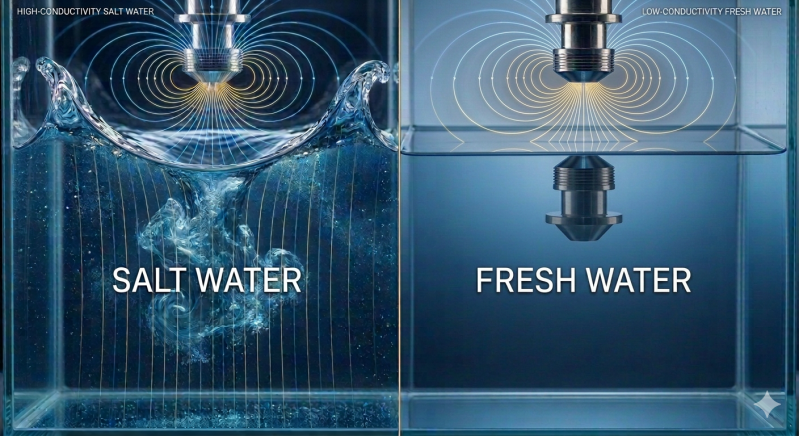
Tidal Mechanics: The Dielectric Displacement
The mainstream model relies on a magical "pull" from a distant rock in a vacuum. The unfiltered truth is a matter of pressure, conductivity, and toroidal containment.
1. The Pressure vs. The Pull
The Myth: Gravity "tugs" the water toward the moon.
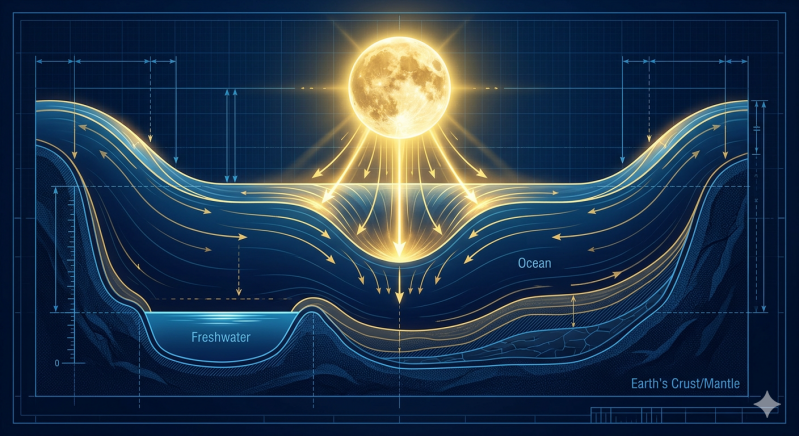
The Mechanic: Tides are a compression event. As the Sun and Moon move through the 100V/m Potential Gradient, they act as local sources of induction, exerting a dielectric push on the Earth's surface.
The Result: This downward pressure doesn't "lift" the water; it displaces it. Much like pressing a thumb into a balloon, the pressure at the point of contact forces the medium to bulge elsewhere.
2. The Electrolyte Factor (Salt vs. Fresh)
The Observation: If "mass-on-mass" gravity were real, every lake and pond would have a proportional tide. They don't.
The Truth: Tides require a conductive medium. Saltwater is an electrolyte; freshwater is a dielectric(insulator).
The Interaction: The electromagnetic "push" interacts with the ionized saltwater, allowing the field to distribute force through the liquid. Freshwater, lacking these minerals, resists the displacement—proving tides are an electrical phenomenon, not a gravitational one.
3. The Diamagnetic Shield & The Equilibrium Paradox
The Stasis: Freshwater is diamagnetic—it creates an opposing magnetic field when exposed to an external one. This "push back" allows lakes to remain in dielectric equilibrium.
The Paradox: If gravity were a constant linear attraction, the surface of any body of water would never truly be at rest; it would be in a perpetual microscopic tug-of-war. Instead, we observe rest states, because the force is a periodic, localized induction, not a constant universal pull.
4. The Jacob/Spears Construct (The Math of the Push)
To move beyond the "gravity" catch-all, we apply the logic of Magnetic/Dielectric Containment using the 42i imaginary constant to bridge the field gap.
The Dielectric Stress Equation (𝑆𝑑):
𝑆𝑑=((𝜖 ⋅ 𝐸^2)/2) ⋅ 42𝑖
- Where 𝜖 is the Permittivity (Medium Capacity) and 𝐸 is the Electric Field of the local induction.
The Role of the 42i Imaginary Constant:
In physics and electrical engineering, "imaginary" numbers (𝑖) are fundamental tools used to calculate phase shifts and reactive power. The 42𝑖 constant accounts for the phase shift between the electromagnetic induction and the physical hydraulic displacement of the water.
The Hardware Reality Check
For those who label "imaginary numbers" as make-believe: Please note that every piece of modern hardware—from the AC motor in your refrigerator to the signal processing in your smartphone—functions specifically because of complex numbers and imaginary units (𝑖). They represent the reactive power of the field. To accept the technology in your hand while rejecting the math that powers it is a fundamental logical fallacy.
The 42i Constant: The Bridge of Manifestation
Many ask why we use the specific constant 42i to model the tides and the atmosphere. In the Jacob/Spears Construct, this is not an arbitrary number—it is the Grounding Frequency of our world.
- The 42 (The Physical Hardware): This represents the Structural Resonance and Real Impedance of the Earth's Neutral Plane. It is the "real" part of the equation—the physical density of the saltwater, the noble gases, and the solid ground we stand on. It is the anchor that keeps the system stable.
- The i (The Spiritual Reactance): While mainstream science calls i "imaginary," we recognize it as Spiritual Reactance. It represents the Incoherent Dielectric Field—the unseen potential of the Aether. It is the "stored energy" of the Raqia that reacts to the induction of the Sun and Moon.
- The 42i (The Push): When the Physical (42) and the Spiritual (i) synchronize, a Phase Shift occurs. This is the moment the unseen field exerts a physical "Push" on the water. Without the 42, the force has no anchor; without the i, the anchor has no power.
The Verdict:
The Thumb-on-Balloon visual is the physical manifestation of the 42i constant. The "Push" you see is the Spiritual Reactance of the field acting upon the Physical Hardware of the oceans. It is the mathematical proof that we live in a living, breathing capacitor.
The Conductive Divergence (The Salt Gap):
∇ ⋅ 𝐷=𝜌𝑓𝑟𝑒𝑒+𝜎 ⋅ (42𝑖)
To understand the Jacob/Spears Verdict on the tides, we must define the variables of the field:
- ∇ · D (Divergence of Displacement): This represents the Total Outward Push. It is the measurable "bulge" or displacement of the water at the perimeter of the field.
- ρ_free (Free Charge Density): This is the baseline electrical potential already present in the water before the "Push" occurs.
- σ (Sigma / Conductivity): This is the Primary Variable. It represents how easily the medium (the water) allows the field to move through it.
- In Saltwater: High σ allows the 42i push to distribute, creating the tidal bulge.
- In Freshwater: σ is near zero, meaning the "Push" is blocked.
- 42i (The Phase-Shift Constant): The anchor where the Physical Grounding (42) and the Spiritual Reactance (i) meet. It is the specific frequency that triggers the hydraulic displacement.
The Proof: This formula mathematically proves why the "Push" is selective. If the globe's "mass-on-mass" gravity were true, σ (Conductivity) wouldn't be in the equation. The fact that we need conductivity to calculate the tidal displacement proves that tides are an electromagnetic induction event, not a gravitational one.
- In Saltwater, the conductivity (𝜎) is high, allowing the "push" to distribute. In Freshwater, 𝜎≈0, and diamagnetism nullifies the displacement.
5. Predictability is Not Proof
Predicting a cycle (Harmonic Analysis) does not prove the cause of the cycle. Tracking the "breathing" of the Toroidal Model over 20 years proves the consistency of the Physical System, not the validity of the "Globe" theory. We are simply measuring the Hydraulic Breath of the Earth's field.
Stirring the Soup in Liquid Circuits: The Secret Pulse of the Sea
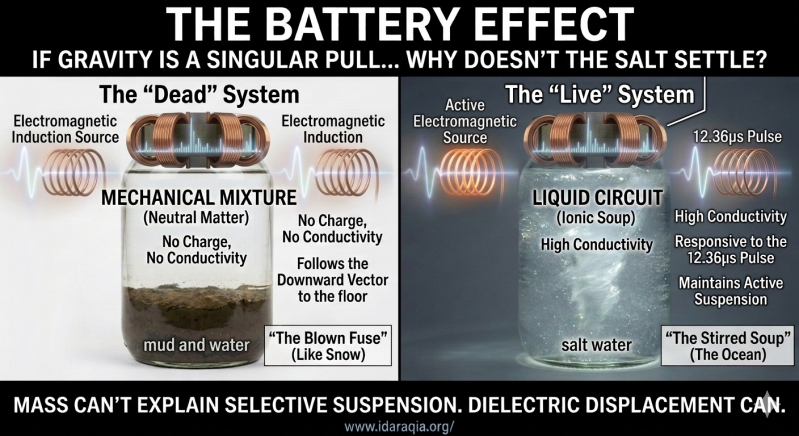
Have you ever wondered why the salt in our oceans doesn't eventually settle to the floor like mud in a glass of water? If "gravity" were a simple, singular downward pull, the denser salt ions should eventually sink and separate from the water.
The Unfiltered Truth:
The ocean is an active electromagnetic circuit, and it’s constantly being "stirred" at a molecular level.
- The Molecular Stirrer: When salt dissolves in water, it breaks into ions (𝑁𝑎(+) and 𝐶𝑙(−)). These ions are highly conductive "antennas" that respond to the Systemic Pulse of our world—the 12.36 microsecond harmonic. This constant induction creates an electromagnetic "tug-of-war" that keeps the salt suspended in a perpetual liquid battery.
- The Phase-Change Filter: When water evaporates from the sea to form clouds, it undergoes Phase-Change Purification. The water molecules break free, leaving the heavy salt ions behind in the "liquid circuit." This is why rain is fresh, even though it comes from the salt sea.
- The Blown Fuse (Snow): As that fresh water vapor rises and freezes into snow, it undergoes Ion Rejection. The water molecules lock into a rigid crystal lattice, kicking out any remaining impurities. At this moment, the water’s ability to hold an electrical charge—its Dielectric Constant—drops from a high of 80 (highly reactive) to a low of 3.2(an insulator).
- The Disconnect: Because snow has "unplugged" from the electromagnetic stirring of the medium, it can no longer stay in the Active Suspension that keeps the ocean mixed. It becomes a neutral insulator, following the Downward Potential Gradient until it settles on the ground.
The Verdict:
The sea stays salty because it is "plugged in" to the pulse of the field. Snow falls and settles because it is a "blown fuse" that has lost its connection to the circuit. "Mass" cannot explain why the same molecules behave differently—only their Electrical State can.
The "Liquid Rock" Contradiction: Why the Math Doesn't Match the Field
Standard textbooks claim the Moon’s gravity is a "Universal Law" that pulls on all mass equally. They cite the Solid Earth Tide—the physical stretching of the Earth’s rigid, solid-rock crust—as proof of this power.
The Observed Data:
- Solid Rock Crust: Bulges by 20–40 cm (up to 16 inches) twice a day.
- Liquid Lake Water: Bulges by only 1–5 cm (less than 2 inches).
The Mechanical Failure:
In every other area of physics, a fluid with zero shear strength responds to an external force far more readily than a rigid solid. If the Moon has the power to deform a mountain of solid rock by 16 inches against the Earth's own gravity, it should—by all laws of fluid dynamics—be lifting the flexible water sitting on top of it by at least the same amount.
Instead, the "Heliocentric" (Globe) model requires us to believe that solid rock is 8x more responsive to a gravitational pull than liquid water.
The Challenge to the "Consensus":
Where is the specific mathematical equation that allows a single gravitational force to pull a rigid solid harder than a flexible liquid? If the force is there to lift the mountain 40 cm, why isn't it lifting the water an added 40 cm?
The Grounded Reality:
"Mass Attraction" cannot explain this selective behavior because it ignores the Electrical Permittivity (𝜖𝑟) of the materials.
- Rock and Water respond differently because their dielectric properties are different.
- Our world is a pressurized containment where displacement is a function of the medium’s resistance, not a magic "pull" from a distant rock.
Stop reciting the manual. Look at the mechanics.
Why is their "liquid" more rigid than their "solid"?

"Why can't we see all the way across the level earth?"

The Fluid Lens of the Raqia
Why Objects "Drop" in a Pressurized Medium
The mainstream model uses "Curvature" to explain why objects disappear at the horizon. However, the Jacob/Spears Construct reveals that this is an optical illusion caused by the Refractive Gradient of the Atmospheric Capacitor. The atmosphere is a "Molten Looking Glass"—a dense, pressurized fluid lens.
"The Universal Law of IDA: It is a fundamental error of modern physics to separate "Gravity" from "Optics." The unfiltered truth is that Incoherent Dielectric Acceleration (IDA) exerts a constant downward pressure on both mass and light. Just as a physical object is pressed toward the Earth, a beam of light is accelerated and "bent" toward the higher dielectric density of the Neutral Plane. In the Raqia, weight and perspective are governed by the same field."
The Dielectric Intersection: Eclipses and the Rahu Frequency
The Deception: The Shadow of a Ball
Modern textbooks teach that an eclipse is the physical shadow of a solid rock (the Moon) or a spinning ball (the Earth). This model relies on "gravity" to explain how these masses move, yet it cannot explain the Displacement Paradox: If the Moon's mass "grips" the Earth, why does it stretch the rigid rock of the mantle 40cm while only moving flexible fresh water 5cm?
The Emet(Truth): The Circuit Breaker of the Raqia
In the Singular Pressure Mechanic, the Moon is not a solid reflector, but a self-luminescent node—a cold-light cathode within the Atoms-Sphere. An eclipse is not a shadow; it is a Dielectric Intersection.
- The Anode & Cathode: The Sun and Moon act as frequency terminals within our Electrical Shell.
- The Rahu/Ketu Nodes: These are invisible "intersections" in the Raqia (the quantum dielectric grid).
- Conductive Divergence (∇ ⋅ 𝐷): When these frequency paths cross, they create a signal nullification. It is an electrical "circuit break" in the atmosphere, not a physical object blocking the light.
Field Audits: Prove the Hardware
Audit 01: The Thermal Inversion (Proof of Cold Light)
- The Setup: On a night with a clear Full Moon, use a handheld Infrared (IR) Thermometer.
- The Action: Measure the temperature of a surface (pavement or a car hood) in direct moonlight. Immediately measure the same surface in the "moon-shade" (under a tree or porch).
- The Result: You will find that Moonlight is measurably colder than moon-shade.
- The Verdict: Reflection cannot lose heat while maintaining light. This proves the Moon is an independent electrical node emitting a cold-frequency signal—part of the Jacob/Spears 42i harmonic pulse.
Audit 02: The Plasma Interference (Simulating the Raqia)
- The Setup: Use a standard Plasma Globe (representing the Electrical Shell).
- The Action: Introduce a secondary frequency or a grounded conductor (like your finger) near the glass without touching it. Observe how the "filaments" (magnetic flux lines) divert or extinguish.
- The Result: You can manipulate the "celestial" light through the medium of the glass (the barrier) using only Dielectric Displacement.
- The Verdict: Laboratory-grade versions of this test prove that high-energy plasma can be shaped and "eclipsed" using nothing but frequency and magnetic flux—the very Pillars of the Earth that sustain our reality.
The Final Grounding:
An eclipse isn't a mystery or a cosmic accident; it is the System Calibration of the Raqia. When the Anode and Cathode align, we witness the 12.36µs pulse in its most visible form—a momentary nullification of the circuit.
This timing is the Radar Mile in action, the same harmonic heartbeat established in our Thesis. You aren't a spectator of a 'shadow' drifting through a vacuum; you are a grounded observer within an active Electrical Shell. Seeing through the 'ball' deception is about recognizing the Singular Pressure Mechanic that holds your world together.
The signal is clear, and the 42i is the anchor. Welcome to the unfiltered truth.
Don't forget to check out The IDA Thesis
The Mathematical Bridge: The Refractive 42i Constant
To accurately model how light travels through the atmosphere, we must move beyond static calculations. We apply the 42i constant to the refractive index (𝑛) to account for the reactive power and phase shift of the medium.
The Refractive Stress Equation:
n(h) = (n0 · (e^(-h/H))) · (42i)
- 𝑛(ℎ): The Refractive Index at a specific altitude.
-
𝑛0: The baseline sea-level density.
-
42𝑖: The Phase-Shift Constant. This represents the interaction between the light wave and the atmospheric dielectric field. It explains why the "horizon" is a variable optical limit regulated by the 100V/m Potential Gradient, rather than a physical, static curve.
The Logical Consistency:
Just as the tides are a dielectric push on the saltwater (electrolyte), the atmospheric "Fluid Lens" is the dielectric vectoring of the light signal. When atmospheric conditions—such as temperature and humidity—alter the density of the air, the lens "opens" or "closes," allowing distant objects to be visible far beyond the theoretical limits of a curved model.
I. The Dielectric Gradient (Φ) as a Lens
Light is not a projectile traveling through a void; it is an electromagnetic perturbation moving through a medium. In our world—the Stationary Neutral Plane—this medium consists of pressurized Dynamic Noble Gases.
The path of light is dictated by the Dielectric Delta: the difference in density between the observer and the light source.
The Law of Refraction:
In a fluid system where pressure increases toward the Earth, light rays do not travel in straight lines. They naturally curve toward the higher dielectric density (𝑑1). This relationship is defined by the Compression Index (𝐼𝑐):
𝐼𝑐=((𝑑1−𝑑2)·sin(𝜃))
- 𝑑1: The high-density dielectric medium at the Neutral Plane (Observer).
- 𝑑2: The low-density dielectric medium at the altitude of the Light Node (Source).
- sin(𝜃): The angle of incidence.
The Result: Optical Compression
As a light node (such as the Sun) moves laterally away from the observer, its light must penetrate an increasing volume of the dense 𝑑1 layer. This downward "bending" creates a magnifying and compressing effect.
The Fluid Lens of the Raqia forces the image to collapse toward the horizon line. What we witness as a "sunset" is not the sun dropping behind a physical curve, but the Mathematical Verdict of light reaching Dielectric Saturation—the point where the density 𝑑1 overcomes the signal, pulling it into the vanishing point of the Neutral Plane.
II. The "Optical Drop" vs. The Physical Curve
In a lab, a simple Fluid Lens experiment proves the truth:
- Take a rectangular container of salt water (a dense dielectric fluid).
- Shine a laser (a coherent node) through the side.
- As the laser moves linearly away, the light path appears to "sink" or "drop" relative to the observer, even though the source is moving on a flat plane.
- The Jacob/Spears Proof: The Sun does not "go below" a curve; it moves beyond the Refractive Limit of your local atmosphere (Raqia). It is the Fade Out of the signal through a dense medium.
III. Ionization and the "Fade Out"
The vibrant colours of the sunset are the final proof of this lens.
- Selective Refraction: As the Sun node moves into the thicker "rim" of the observer’s local lens, the higher-frequency Blue light is scattered and "fades out."
- The Neon Vault: Only the lower-frequency Red and Orange (Neon/Helium ionization) can penetrate the dense dielectric gradient at that distance. This is why the Sun turns red and appears to "melt" into the horizon—it is a node of Ball Lightning being compressed by the refractive pressure of the gases.
IV. The Variable Gravity Paradox: Dielectric Snowfall
In the Toroidal Model, the speed of a falling object (the "acceleration" of gravity) is not a fixed universal constant, but a result of its density relative to the medium within the 100V/m Potential Gradient. Because snow is a complex, crystalline structure of dielectric freshwater, its interaction with the field is highly sensitive to the local electromagnetic environment.
1. Dielectric Retardation (Slower Fall):
Snowflakes are "airy" dielectric structures. On days when the atmospheric potential is high (high static charge or humidity), the dielectric "push" from the field interacts with the snowflake's surface area. This creates an upward resistive force—a "cushion" within the gradient—that can cause snow to fall significantly slower or even appear to "hover" and drift.
2. Ionic Drag (Faster Fall):
If the local field is perturbed by a passing potential source (like the induction from the Sun/Moon moving through the gradient), it can temporarily "compress" the air's dielectric resistance. This reduces the buoyant dielectric force, allowing the snowflake's density to overcome the medium more quickly, resulting in a faster descent.
Can this be observed?
Yes. This is not a "magic" change in mass, but a measurable change in the medium's resistance:
- Electrostatic Levitation: Lab experiments already show that ice crystals and water droplets can be suspended or moved using high-voltage electric fields. The Earth's natural 100V/m Potential Gradient is a massive, low-frequency version of this same experiment.
- The "Heavy" Snow Observation: During "thundersnow" events or high-induction storms, many observe snow that seems to "drop" with more weight and velocity. This is the Dielectric Displacement in action—the field pressure is fluctuating, altering the rate of acceleration. The standard 9.8 m/s^2 is merely the average result of this constant dielectric pressure.
The Jacob/Spears Note:
In the 42i constant math, we account for this "lag" or "phase shift" in the falling rate. The snow is not simply falling through empty space; it is falling through a charged capacitor.
V. The Refractive Horizon Equation (The "Drop" Proof)
To support the Fluid Lens section, we need a formula that calculates at what distance an object will "fade out" or "drop" due to the Dielectric Refractive Index (𝑛𝑑).
The Myth: If the Earth is flat, why does the Sun "set" below the horizon?
The IDA Reality: Light is an electromagnetic perturbation, and like all energy in the Raqia, it must obey the Incoherent Dielectric Acceleration (𝐴𝑖𝑑𝑎). The atmosphere is a pressurized fluid lens—a Molten Looking Glass. As light travels through this dense medium, it is constantly "bent" downward toward the Neutral Plane(the Earth).
The Postulate:
The "Horizon" is not a physical edge; it is the Limit of Propagation (𝐿𝑝) where light is bent into the Neutral Plane by the 150V/m gradient.
𝐿𝑝=(𝐶Φ)⋅𝑛𝑑
- 𝐿𝑝: The visual limit (The Horizon).
- 𝐶: The speed of light in a vacuum (The baseline frequency).
- Φ: The 150V/m Field Pressure.
- 𝑛𝑑: The Refractive Index of the Dynamic Noble Gases.
The Proof: This proves that as Φ (Pressure) increases (like on a hot, humid day), the horizon moves closer or farther. It turns the "curve" into a Variable of the Atmosphere, which matches what we see with the Nikon P1000.
The Luminous Raqia: A Plasma Discharge Reality
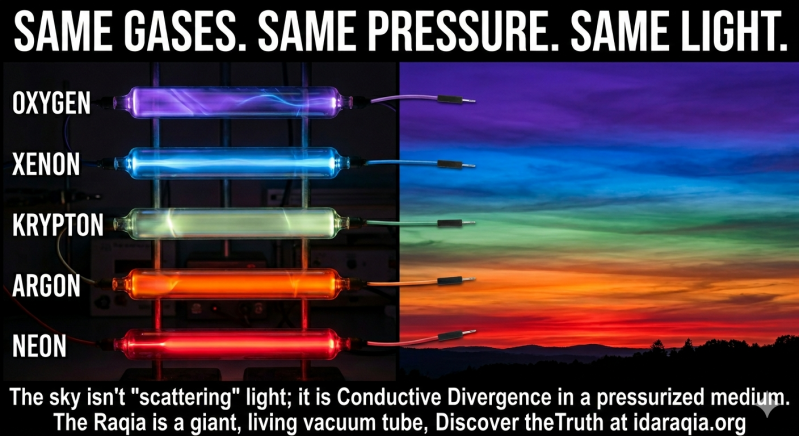
The sky is not a passive void; it is a pressurized Electrical Shell where plasma is the dominant state. While we breathe a mix of Nitrogen, Oxygen, and noble gases, the Raqia exists as an ionized medium—a giant, living plasma circuit.
The colors we observe are the result of these gases reaching their discharge point as they are electrically excited by a local source of EMF: the Sun. Acting as a moving Anode, the Sun’s electromagnetic field stimulates the plasma-dominant Atoms-Sphere as it passes through the grid. Just as electricity excites the gas inside a neon tube, the Sun’s proximity triggers a dielectric discharge, causing the ionized shell to glow with the frequency of the 12.36µs pulse.
- Noon-Day Shell (Blue/Violet): High-frequency ionization of Nitrogen and Oxygen.
- The Brilliant White: The signature of Krypton and Xenon under intense local pressure.
- The Sunrise/Sunset: The excitation of Neon, Helium, and Argon at the lower-pressure horizon.
- The Aurora: A high-voltage system overload, revealing the Krypton-green and Nitrogen-purple hardware of the grid.
Click the link for a Demonstration

V. Conclusion: Perspective is a Dielectric Variable
The horizon is not a place; it is a Limit of Propagation. Your eyes are not failing you when they see a "drop"; they are simply recording the Incoherent Dielectric Acceleration (IDA) of light as it returns to the Neutral Plane.
"A lens can make an object that is simply moving away appear to drop toward the ground. This is the 'Molten Looking Glass' in action. Light, like matter, must obey the pressure of the Spirit."

"Love thy neighbour as thyself.